
Digital assets — such as cryptocurrency (including Bitcoin), online investment platforms and other digitally held assets — are becoming increasingly common, even if they are not widely discussed or fully understood across the Scottish Borders. This article looks at digital assets Scottish law considerations, particularly how they relate to wills and estates.
While many people still associate digital assets with specialist investors or technology enthusiasts, they are now appearing more frequently in estates and financial planning.As a result, solicitors and accountants are paying closer attention to how Scots law treats digital assets.
Recent developments suggest this is an evolving area of law, particularly in relation to wills and executry.
What Are Digital Assets?
Digital assets are assets held electronically rather than in physical form. They can include:
- Cryptocurrencies such as Bitcoin or Ethereum
- Assets held on online investment or trading platforms
- Digital tokens or blockchain-based assets
Some people actively invest in these assets. Others may hold them through financial apps or platforms without thinking of them as legally distinct from more traditional investments.
Why Digital Assets Have Been Legally Uncertain
Scots property law relies on long-established categories of property. Digital assets do not sit neatly within these frameworks, which has led to uncertainty, particularly when dealing with estates.
In practice, this has raised several practical questions, including:
- Do digital assets form part of a deceased person’s estate?
- Can an executor deal with them?
- How are they identified and transferred?
Until recently, there has been no clear statutory framework addressing these issues.
What Is Changing in Scotland?
The Scottish Parliament has introduced a Digital Assets (Scotland) Bill, which has received support at committee stage. The Bill aims to clarify that certain digital assets can be recognised as a form of property under Scots private law.
It is important to be clear: this legislation is not yet in force, and it does not resolve every practical issue. However, it represents a significant step towards greater legal certainty and reflects the direction of travel in this area of law.
Further information can be found on the Scottish Parliament’s Digital Assets (Scotland) Bill page.
Why This Matters for Wills and Executory
In practice, digital assets can be easily overlooked when someone dies.
They are often:
- Subject to technical security measures
- Held on overseas or online platforms
- Unknown to family members or executors
It is also important that your attorney or executor knows where key digital information is held. Without access to this information, they may be unable to identify or manage digital assets, even where those assets are legally part of an estate.
Without clear planning, assets such as cryptocurrency or online investments may be missed during estate administration, even where they have clear value.
As this area of law develops, it is increasingly important that:
- Wills take account of digital assets
- Executors are alert to the possibility that digital assets form part of an estate
- Estate planning reflects how people actually hold value today
Importantly, this is not investment advice. It is about ensuring estates are administered fully and accurately.
You can read more about reviewing your estate planning in our Making a Will in Scotland guide.
A Practical Issue, Not a Technical One
You do not need to understand how digital assets work at a technical level to be affected by them legally. What matters is whether an asset exists, who owns it, and how it can be dealt with after death.
As digital assets become more mainstream, solicitors and accountants must ensure that advice on wills and executory keeps pace — carefully, accurately, and without speculation.
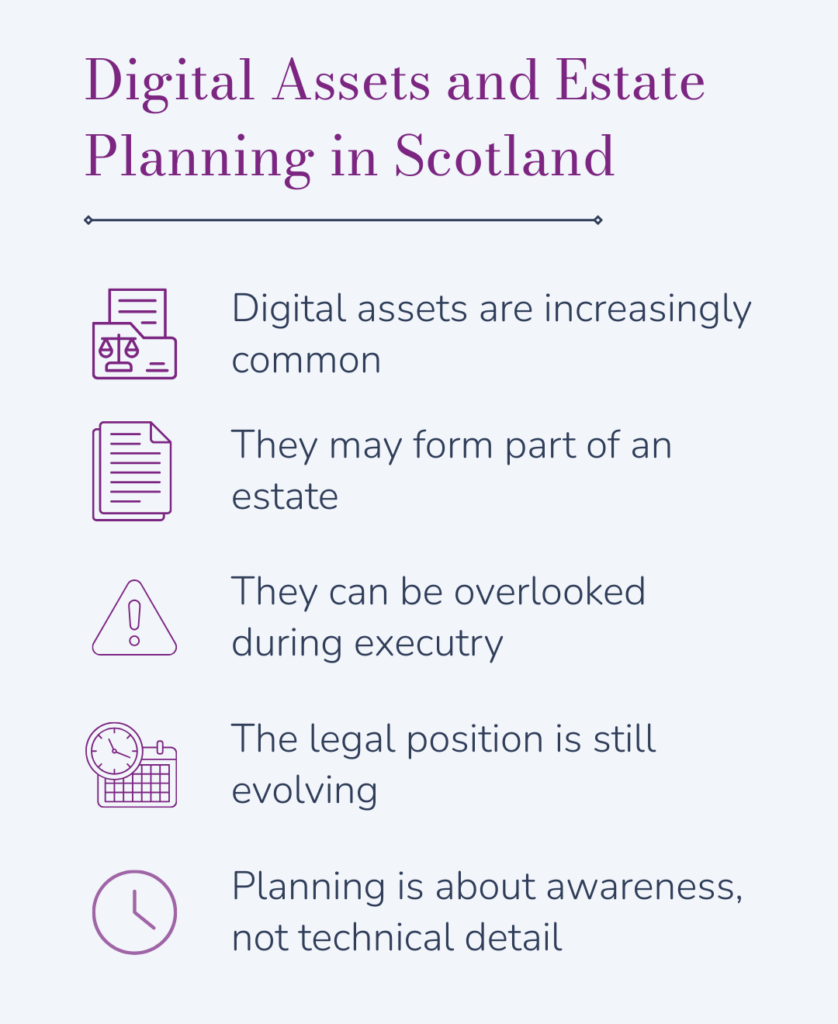
Questions People Are Starting to Ask About Digital Assets
As digital assets become more common, these are some of the questions that are beginning to arise. The legal position is still evolving, and answers may depend on individual circumstances.
What counts as a digital asset?
Digital assets generally refer to assets held electronically rather than in physical form. They can include cryptocurrency, assets held on online investment or trading platforms, and other digitally recorded forms of value. Not all digital assets are treated the same way in law.
Do I need to own Bitcoin for this to affect me?
No. Bitcoin is simply the most well-known example. Many people hold digital or platform-based investments without thinking of them as “digital assets” in legal terms.
Are digital assets automatically included in an estate?
Not always. Whether a digital asset forms part of an estate can depend on how it is held and how the law applies to that type of asset. This is an evolving area of Scots law, which is why advice is important.
What happens if digital assets are not identified when someone dies?
If the existence of digital assets is not known, they may be overlooked during estate administration. This can lead to delays or difficulty dealing with the estate, even where the assets clearly have value.
Should digital assets be mentioned in a will?
In many cases, yes. Even a brief reference can help reduce uncertainty during executry and prompt further enquiries where necessary.
If I already hold digital assets, what should I do now?
If digital assets form part of your wealth, it is sensible to discuss them with a solicitor as part of your wider will and estate planning. Recording their existence and your intentions can help ensure assets are not overlooked, even while the law continues to develop.
Is the law on digital assets in Scotland settled?
No. Proposed legislation aims to clarify how certain digital assets are treated under Scots law. Further guidance is expected as the law continues to develop.